Kinky Boots
The 2005 Comedy Movie
This was the official website for the 2005 comedy movie, Kinky Boots.
Content is from the site's archived pages as well as from other review sources.
Rating: PG-13 (for thematic material involving sexuality, and for language.)
Genre:Comedy, Drama
Directed By:Julian Jarrold
Written By:Tim Frith, Geoff Deane, Tim Firth
In Theaters:Apr 8, 2006 limited
On Disc/Streaming:Sep 5, 2006
Runtime:106 minutes
Studio: Miramax Films
Kinky Boots (2005) - Movie Trailer
Charlie Price faces the impending shut down of the Northampton shoe factory that his family has owned and operated for generations. Just when he feels that all is lost, he has a chance encounter with Lola, a flamboyant transvestite cabaret star. Lola's desire for stylish, kinky boots for herself and her colleagues provides a glimmer of hope for the factory and its employees.
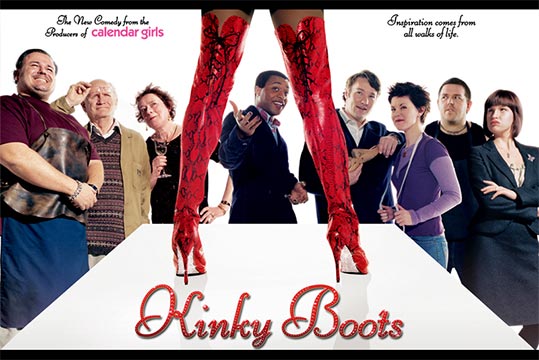
Kinky Boots Quotes
-
Lola: Perhaps what women secretly desire is a man who is fundamentally a woman.
-
Harold Price: The first thing you notice about a person is their shoes.
-
Harold Price: I think it's a shoe.
-
Harold Price: Okay,now, Charlie. I'm going to show you the most beautiful thing in the world. Do you know what it is?
Charlie Price: A shoe.
Harold Price: A lot of people would say it'd be an oak tree.
Charlie Price: It's a shoe.
Harold Price: A lot of people would say it'd be a field of woodland flowers.Do you know what I think it is, Charlie?
-
Lola: Look to the heel, young man. The sex is in the heel.
TOMATOMETER CRITICS 57% | AUDIENCE 74%
CRITICS REVIEWS
Overall, it's breezy, forgettable fluff, but 'kinky'? Obviously, the term is relative.
June 24, 2006
Trevor Johnston
Time Out
Top Critic
You'll giggle and laugh and never look at those things on your feet the same way again.
May 26, 2006 | Rating: 4/5
Roger Moore
Orlando Sentinel
Top Critic
It's a predictable and preachy stab at a comedy with heart, and its subversive silliness is eclipsed by an overwrought humanity.
May 19, 2006 | Rating: 2.5/4
Bruce Westbrook
Houston Chronicle
Top Critic
It's a feel-good movie that happens to dress in drag.
May 18, 2006 | Rating: B
Chris Vognar
Dallas Morning News
Top Critic
Oh, do come in, love -- welcome to the Twee Brit Comedy Factory.
May 13, 2006 | Rating: D
Steve Murray
Atlanta Journal-Constitution
Top Critic
Ejiofor's latest, Kinky Boots, may not enshrine itself in the halls of movie greatness, but it proves that this versatile British actor can do nearly anything.
April 28, 2006 | Rating: B
Robert Denerstein
Denver Rocky Mountain News
Top Critic
Brit comedy is more warm and quirky than kinky.
December 18, 2010 | Rating: 4/5
Heather Boerner
Common Sense Media
The film falls short of its initially obvious dramatic goals due to the shallow depths that screenwriters Geoff Deane and Tim Firth take their characters.
April 19, 2009 | Rating: C
Cole Smithey
ColeSmithey.com
What Kinky Boots has going for it is a terrific performance from Chiwetel Ejiofor as Lola, who serves as the emotional heart of the film.
July 10, 2007
Felix Gonzalez Jr.
DVD Review
It's cheerful, predictable and far from edgy, but buoyed by a likable cast and a standout performance by the versatile Chiwetel Ejiofor.
February 22, 2007
Kevin Lally
Film Journal International
Kinky Boots stands out for 3 reasons: 1. It's inspired by a true story. 2. It's about what it really means to be a man AND the power of fabulousness. 3. It has the formidable Chiwetel Ejiofor in drag, singing!
January 31, 2007 | Rating: 4/5
Karina Montgomery
Cinerina
A tepid crowd-pleasing Brit comedy/
Dennis Schwartz
Ozus' World Movie Reviews
Kinky Boots Movie Review
Roger Ebert
April 20, 2006
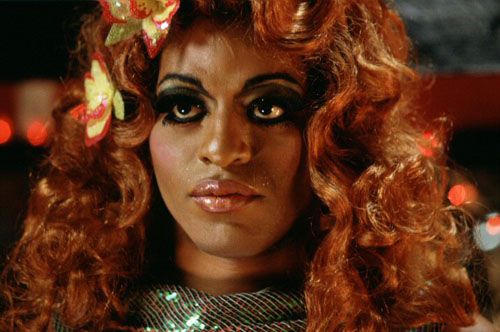
One of the gifts of movies is the way they introduce us to new actors, turning them this way and that in the light of the screen, allowing us to see the fullness of their gifts. Consider Chiwetel Ejiofor, whose first leading role was in "Dirty Pretty Things" (2002), as a Nigerian doctor reduced in London to working in a mortuary. Then came a romantic role in "Love Actually" (2003), a South African activist in "Red Dust" (2004), a space opera villain in "Serenity" (2005), and a New York detective in Spike Lee's current "Inside Man" (2006). Along the way he has worked for Steven Spielberg, Woody Allen and John Singleton (a vicious mobster in "Four Brothers" in 2005) and has done Shakespeare and The Canterbury Tales for TV. Born in London in 1974, he works easily with British, American and Nigerian accents.
Now he plays a drag queen in "Kinky Boots." It is a performance all the more striking because he doesn't play any kind of drag queen I've ever seen in the movies. He plays the role not as a man pretending to be a woman, and not as a woman trapped in a man's body, and not as a parody of a woman, and not as a gay man, but as a drag queen, period: Lola, a tall, athletic performer in thigh-high red boots who rules the stage of a drag club as if she were born there, and is a pretty good singer, too. In preparing for the role, Ejiofor must have decided not to simper, not to preen, not to mince, but to belt out songs with great good humor that dares the audience to take exception. If "simper," "preen" and "mince" are stereotypical words, well, then, most drag queens, including Lola's backup dancers, are stereotypical performers. Not Lola.
With "Kinky Boots," we find ourselves watching another one of those British comedies in which unconventional sex is surrounded by a conventional story. The film's other hero is Charlie Price (Joel Edgerton), whose father dies and leaves him a Northampton shoe factory that is nearly bankrupt because men aren't buying traditional dress shoes. Through a coincidence we must accept, Charlie meets Lola, who complains that women's shoes don't stand up to the weight of a full-sized man in drag. Charlie thinks maybe his factory could supply a proper pair of boots with stiletto heels for Lola, and lovingly crafts the boots himself, only to hear Lola respond: "Pease, God, tell me I have not inspired something burgundy." What does he prefer? "Red! Red!"
Lola comes to Northampton to design a line of footwear, receiving a chilly reception from some of the union men in the factory, especially the gay-hating Don (Nick Frost). Don is the reigning arm-wrestling champion in a local pub, and of course, it is only a matter of time until Don and Lola are elbow to elbow in a showdown. Meanwhile, Charlie's snotty fiancee Nicola (Jemima Rooper) is a real estate agent, hoping to recycle his factory into condos, while the plucky shoe worker Lauren (Sarah-Jane Potts) believes in Charlie, Lola and the factory.
Kinky Boots (Film) Review
Kinky Boots Reviewed
April 11, 2016 Christa Bass
Kinky Boots (2005)
Director: Julian Jarrold
Stars: Chiwetel Ejiofor, Joel Edgerton, Sarah-Jane Potts, Nick Frost
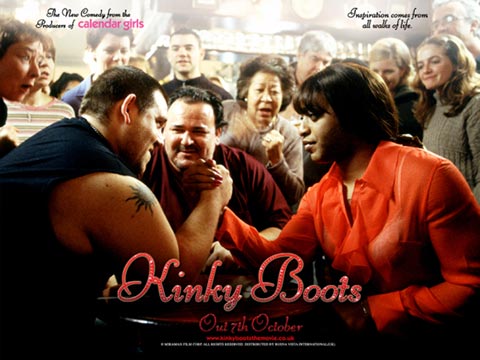
IMDB Synopsis: A drag queen comes to the rescue of a man who, after inheriting his father’s shoe factory, needs to diversify his product if he wants to keep the business afloat.
My Review:
Well, this was just the ideal film to view on a Sunday afternoon because it’s joyous, frankly. I know I’m jumping the gun a little and I’ll rein it for now but I had so much fun being involved that I might as well have been stitching thigh high boots next to Nick Frost myself.
Anywhoo. We start with a cheeky little insight into the childhoods of the two men we’ll come to know as the main characters of this fabulous (and true!) tale.
Lola (Ejiofor), who is Simon as a child, has an epiphany in a pair of red heels (they are always red heels) much to the disdain of his strict and unforgiving father. Meanwhile, young Charlie (Edgerton) learns first hand the importance of a damn good Oxford brogue and all that goes with it.
Many years later, Charlie has finally flown the nest, leaving behind his father’s shoe factory for a life in the city with his fiance, Nicola. Tragically, before the couple have even closed the door on their first night in their new life, Charlie receives the call to say that Mr Price (Robert Pugh) has passed away.
Back in the family business and unclear about the future, Charlie quickly realises that things aren’t looking great financially. In short, the original Mr P wasn’t a great business man and he’s been running the factory into the ground.
Charlie does what he can to sort it and on a mad dash to London to offload some stock, accidentally gets himself involved in a street assault. Being on the goofy side, it’s Charlie who ends up most injured, even though he’s supposed to be the saviour. Lola’s the one being attacked, though really, she’s doing just fine without assistance.
Lola is brusque and Charlie isn’t exactly comfortable when it’s revealed who Lola is but he has a look around the nightclub she works in (where he finds himself recovering) and then goes on his merry way.
He doesn’t give Lola another thought what with being so busy having to lay off staff and frantically find a way out of the factory going bust. When he lets Lauren (Potts) go, he gets a mouthful about diversifying the product but comes up short on a good idea. At first anyway.
Eventually the penny drops and an excited Charlie ropes Lauren into a trip to the Big Smoke where they meet Lola at the club and float their idea past her- shoes for transvestites. Lola’s into it as, conveniently, she’s been suffering with pinched feet in stilettos for years. She even agrees to travel up to Northampton to pick up her first pair of boots in person, though Charlie tries to persuade her otherwise.
“The fuck you just say about my jacket?!”
Predictably – but oh so fabulously – Lola arrives in full drag and causes quite the stir with the factory workers. There’s nothing new here as Nick Frost mistakes her for a ‘real woman’ and catcalls her publicly, only to be shot down with the truth in front of his colleagues.
I love Nick Frost with every fibre of my being and I hate that he’s the worst in this, although of course, of course he’ll eventually redeem himself, revealing that he’s a teddy bear really with a heart of gold. But it takes a while, a truckload of homophobia and an arm wrestling challenge for him to start changing his mind about Lola, and to start to grow as a human being.
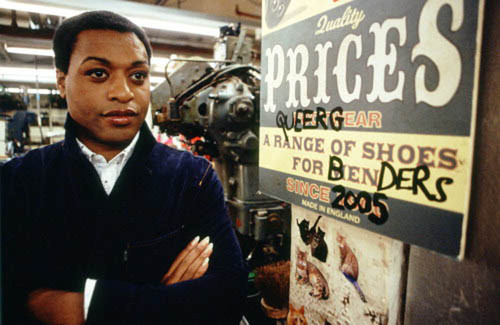
“At least his grammar’s on fleek…”
Lola, in fact, has some growing of her own to do and turns up to the factory on the second day without her finery. (Chiwetel is ridonkulously sexy in any outfit at all times, I’m sorry). Nick Frost is mean to her and manages to completely derail her, which comes as a surprise to Charlie, and perhaps to us, the viewers.
You see, Lola is a born performer with no fear but she’s the Sasha Fierce to Simon’s Bey and I think we can all understand that. Lola and Charlie have a heart to heart about their lives and Lola lets Simon in about his father, a boxer who disowned him and then died before they were able to reconcile. (Well, of course I sobbed).
Lola then starts to stand up for herself against the work bullying (which really only comes from one person) by asking Nick Frost what she has to do to ‘be a man’ (hence the arm wrestling). The other workers are a mixture of fascinated/bemused by Lola, with some of the men asking well-thought out (if probing) questions about her sexuality and why she dresses the way she does if she doesn’t want to sleep with men.
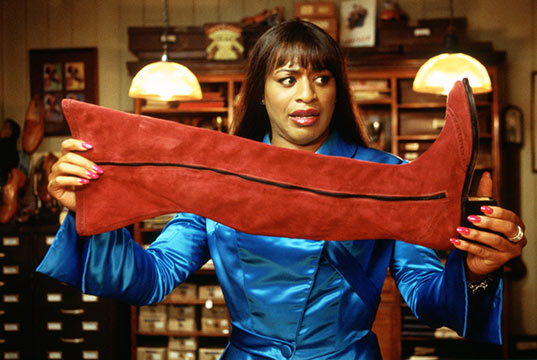
“Fabulous does not come with a flat heel, people!”
FYI the first prototype of the first boot does not go down well so Lola sticks around to be the designer. Obvs. She wants heels heels heels so one of the most endearing parts of the film is where some of the old school workers come up with an idea for a reinforced steel stiletto heel. Cuuute – but also: deadly.
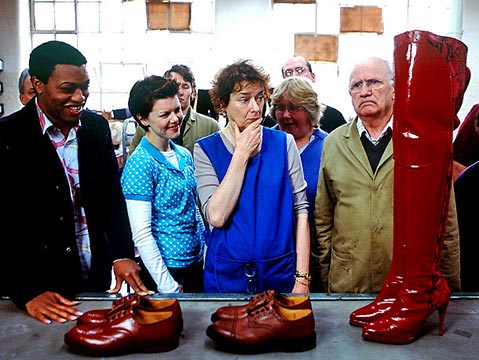
“Not really sure they’ll offset the tabards, mind…”
Charlie, while all this excitement occurs is trying to hold on to his fiance (correction: she is the worst) who is pushing him to sell the factory so they can start their life. She’s also desperate for a Jimmy Choo wedding and is massively unsympathetic about anything that doesn’t involve her.
She’s a monstrous caricature of a woman who is not right for Charlie at all and you’ll never guess what she goes and does, thus leaving him safe to pursue the success of his factory – fashion show in Milan, baby! – and another nearby romantic interest…
Mysterious this plot it not but it’s as familiar as your favourite pair of pajamas and that’s what makes it so bloody lovely.
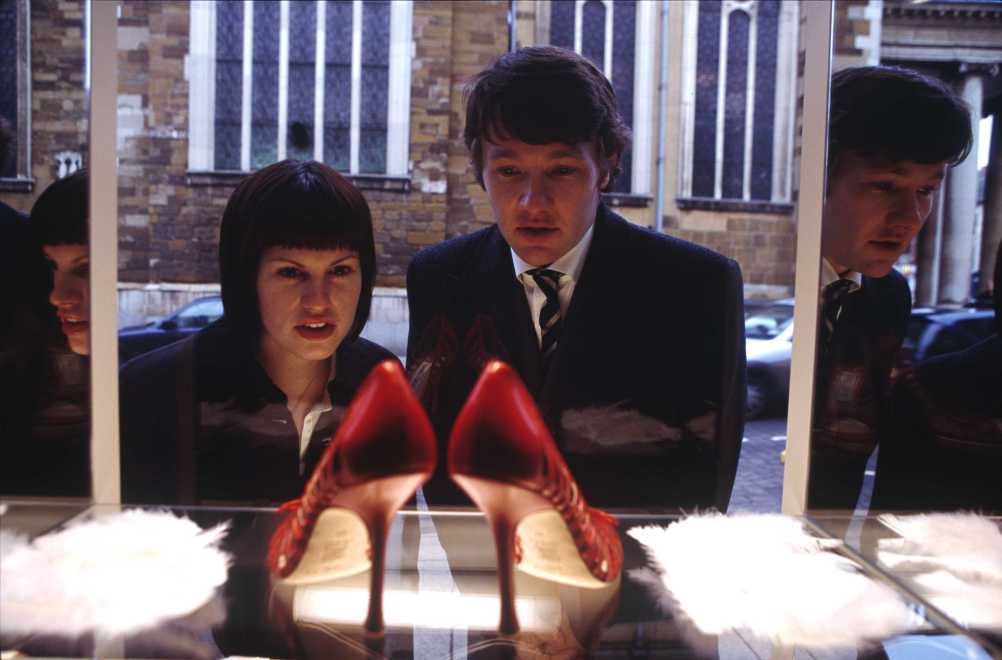
Some women just don’t deserve nice shoes
It’s not all fun and games for a while though, as Charlie remortages his home (without telling Bitchy Nicola) to fund a slot on the catwalks of Milan (as you do right off the bat). In the lead up to Milan tensions rise among the staff, and there are harsh words and walk outs (but the opportunity of redemption for one worker, praise the Lord!).
Charlie also rows with Lola by accident (on the night he finds out Bitchy Nicola ain’t nothing but a lyin’ cheat), and says a few things he can’t take back. This sends Lola sashaying furiously (but actually deeply hurt) back home to London which doesn’t bode well for Milan and the planned catwalk show.
I’ll park it here just in case you’ve not got round to seeing this beauty yet (you’re nearly 11 years late, yo) but not before everyone’s favourite section.
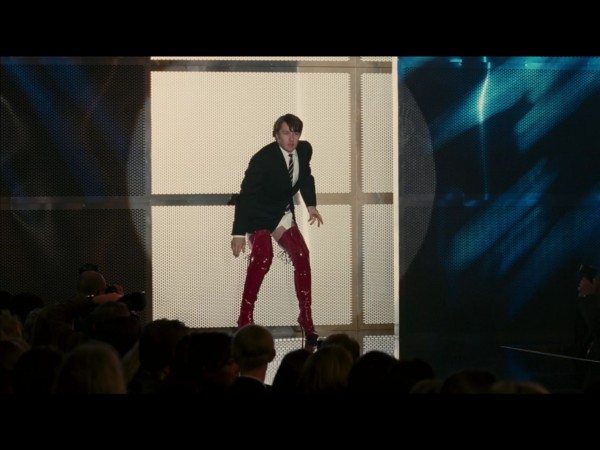
The thigh’s the limit in this rather *spoilery* scene
Questions:
Will the show, as they say, go on in Milan or will everything fall apart spectacularly? Will Lola ever forgive Charlie for his unkind words? Will Charlie get the girl (a decent one this time)?
And what, finally, will become of the shoe factory and all the lovely workers? Only one way to find out for your own sweet selves!
My Thoughts:
I like any film that’s about accepting yourself and both our leads have work to do on that front (#selflove). Both men need to work their way out from the shadows of their separate family histories: Lola to let go of regret and guilt, Charlie to find his was along his own shoe strewn path.
It’s sad at times but overall wonderful, hopeful and fucking fabulous. Lola is a dream character with so much warmth to give, while Charlie is a wet wipe who finally comes through at the last hour.
All the performances are spot on but it won’t surprise you to note that my fave, Nick Frost steals the show as far as I’m concerned. It’s not nice to watch a hero sneer his ignorance across the screen but I feel like he nails the narrow mindedness of a small town individual perfectly and then comes through like a motherfucking boss. That’s my boy.
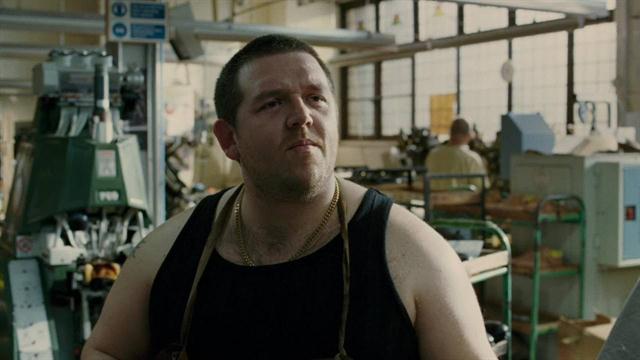
Nick Frost for Magic Mike 3 please
I have no criticisms except this: Bitchy Nicola flees the restaurant she’s in with her lover when Charlie turns up but leaves behind her Choo on the pavement? I don’t buy that at all. Sure it’s a loose Cinderella reference but there’s no way I’d leave my £400 shoe for anyone, no sir – and neither would she.
My Rating: 5/5. It’s not perfect by any means but I love it so it gets the full five. So sue me.
AUDIENCE REVIEWS
.
**** Carol G
December 29, 2016
A very satisfying movie, funny and touching too!
+++
***** Melissa R
August 12, 2016
Excellent movie. Must see!! Funny and heartfelt with a beautiful message.
+++
***** Theresa H
July 7, 2016
How is this movie only getting a 74 percent from audiences? It's a great, fun and life telling story. Great actors...etc. Glad I watched. Want to see the Broadway show now!
+++
**½ Farah R
June 9, 2016
It's okay. Weird. But okay.
+++
*** Rebecca S
February 25, 2016
Kind of charming. Kind of boring. Worth it for Chiwetel Ejiofor, though.
+++
** ½ Lewis E
January 1, 2016
Only noteworthy aspect is Chiwetel Ejiofor's performance as the vibrant and heartfelt Lola in what is an otherwise bland British comedy. I imagine the kinkiness is better served in the musical play.
+++
**** Bee Bee O
September 20, 2015
I love this movie. A beautiful story. Excellent acting. Would have liked to watch another 45 minutes to really allow all of the characters to develop. This is a movie that everyone can watch and that pleases me greatly.
+++
**** Michael D
September 5, 2015
Fabulous preparation for the musical!
+++
Super Reviewer
*** Jesse O
August 31, 2015
The Brits are the best at this sort of entertaining fluff that doesn't really go as deep as it could or, in some cases, should. The use of the word fluff might seem like an insult, but I really don't mean it that way honestly. Because, and there have been some cases, it's usually really rare for me to dislike movies like this. I just think the British just do a better job at presenting this type of film in an entertaining fashion than the Americans do, but that's just me.
Love, Actually comes to mind instantly as something that's super light and fluffy, but it's actually a real good movie on top of that as well. I'm not suggesting that this even comes close to how great Love, Actually was, but the style, not the structure, is certainly similar. With that out of the way, I will say that this movie is pretty much exactly what you would expect it to be. A transvestite finds himself working in a shoe factory to help keep it afloat for his new friend. Seeing that the shoe factory itself is in one of those small, simple towns then you can pretty much expect to see some 'fish out of water' stuff, like how they adjust to Lola being a transvestite and how they treat him at first.
You can see where this is going. Respect is earned and people become a little more tolerant to others' differences as opposed to hating them for it. Again, this is a movie that you've seen before, countless times, and you will see again, countless times. But, as I mentioned, the film more than makes up for it in spirit, energy and an excellent performance from Chiwetel Ejiofor. I mean, this guy is so fucking great. And I don't mean just in this movie, even though he is great here, I just mean in general.
This guy is a fantastic actor and I honestly wish that his character here would've been developed more than he was. It's like they hint at a very difficult childhood and relationship with his father, but they only show bits and pieces of it. I suppose since it, most likely, would've been a downer when compared to the rest of the film, then they just left it out, to keep the film at a lighter tone. In its place there's the obvious down part of the film where Charlie pushes Lola away due to his Charlie's own personal problems at the time. Again, just the usual stuff. I just think that the film really wastes an opportunity to tell a deeper and more emotionally resonant arc with Lola/Simon.
It might have been cliched and predictable and maybe even sentimental, but it would've offered up some insight into the film's most interesting character. It is what it is, but I cannot complain about the cast of the film. Chiwetel and Joel are both great, but Chiwetel, clearly, steals the show. That's about it really, I got nothing else to say. It's an easy film to watch, it could have been worse, but I'm not gonna complain because I definitely had a good time watching.
It's not what I would call particularly deep or complex, but it's a good movie nonetheless. Solid Netflix watch, at best.
+++
*** Ricardo R
August 17, 2015
Entertaining? yes, formulaic? totally, kinky? In no way.
+++
*** Justin B
July 25, 2015
Fun and bighearted but it never truly capitalizes on its premise; often playing things too safely.
+++
**** Case B
April 19, 2015
In the tradition of Billy Elliott & Toast. Great performances and message.
More Background On KinkyBoots-Movie.com
KinkyBoots-Movie.com is associated with Kinky Boots, the 2005 British comedy-drama that transformed an unusual true story from England’s traditional footwear industry into an international entertainment property. The website originally served as an official online destination for the movie, while its present incarnation functions primarily as a retrospective resource containing information about the film, its story, quotations, reviews, and audience reactions.
The film was directed by Julian Jarrold from a screenplay by Geoff Deane and Tim Firth. Its principal cast includes Joel Edgerton as Charlie Price, Chiwetel Ejiofor as Lola, Sarah-Jane Potts as Lauren, Jemima Rooper as Nicola, Linda Bassett as Melanie, and Nick Frost as Don. Miramax was closely associated with the movie and continues to maintain an official Kinky Boots film page featuring its synopsis, cast and crew information, clips, trailer, and awards information.
The original movie website belonged to an era when a dedicated domain was a standard part of a film's promotional campaign. Rather than expecting audiences to find a title through social media accounts, streaming applications, or studio-wide movie databases, distributors commonly established individual websites around theatrical releases. A memorable domain such as KinkyBoots-Movie.com could therefore act as a central destination for moviegoers who had encountered the title through a trailer, advertisement, review, film-festival screening, or theatrical poster.
Today, the domain is interesting for another reason. Kinky Boots proved to have a cultural life far beyond its initial theatrical run. What began as a British film inspired by a struggling Northamptonshire shoe company eventually became the basis of an enormously successful Broadway musical. Consequently, KinkyBoots-Movie.com documents an early stage in the evolution of a story that eventually reached audiences around the world.
What Kinky Boots Is About
At its simplest, Kinky Boots is a story about saving a failing business by recognizing a market that established manufacturers have overlooked.
Charlie Price has grown up around his family's Northampton shoe factory, Price & Sons, but does not particularly want to inherit the business. His plans change after his father's death leaves him responsible for a company whose traditional men's shoes are no longer selling in sufficient quantities.
The factory is not merely a financial asset. It supports employees whose families and community connections make closure a human as well as a commercial problem. Charlie initially sees few alternatives to layoffs.
His outlook changes after meeting Lola, a charismatic London drag performer. Charlie realizes that performers such as Lola face a surprisingly practical footwear problem: conventional women's high-heeled boots generally are not engineered to support the weight and dimensions of male wearers.
That problem suggests a niche.
Instead of continuing to manufacture traditional shoes for a shrinking market, Price & Sons could make glamorous women's-style boots engineered specifically for male customers. Lola eventually becomes much more than a potential customer. She contributes ideas, challenges Charlie's assumptions, and helps shape the proposed product line.
The resulting story combines workplace comedy, entrepreneurship, fashion, family expectations, prejudice, friendship, and questions about masculinity and identity. A planned appearance at a footwear show in Milan provides the narrative with its commercial deadline and flamboyant climax.
Although the film's title and marketing emphasize outrageous footwear, its underlying business premise is remarkably conventional: when the existing market for a product disappears, survival may depend upon understanding an underserved customer better than established competitors do.
The Remarkable True Story Behind the Movie
One of the most important facts about Kinky Boots is that its central business idea was inspired by real events.
The story can be traced to W.J. Brookes & Co. in Earls Barton, Northamptonshire. Founded in 1889, the company had generations of experience producing footwear. Steve Pateman entered the family business as a teenager and eventually became its managing director.
By the late 1990s, however, traditional British footwear manufacturers faced severe economic pressures. Pateman's company was struggling, orders were declining, and jobs were threatened.
Then came an unusual inquiry.
A footwear retailer serving the fetish and cross-dressing market wanted women's-style footwear manufactured in men's sizes. Pateman recognized that this was not simply a request for larger women's shoes. The footwear needed to be designed differently because high heels intended for women might not safely withstand the weight of a larger male wearer.
Pateman invested in machinery capable of attaching approximately four-and-a-half-inch heels and developed reinforced designs incorporating structural support. The resulting range was marketed under the name Divine Footwear.
The contrast was irresistible: a traditional Northamptonshire shoe manufacturer surviving by producing dramatic thigh-high boots for male customers.
The BBC recognized the story's potential and featured the company in its Trouble at the Top documentary series in 1999. That real-world business story subsequently provided the inspiration for the fictionalized Kinky Boots.
The film therefore did not simply invent a clever premise. Its central concept—an old-fashioned footwear manufacturer finding a new market by making glamorous boots capable of supporting male wearers—grew directly from an innovative attempt to preserve a genuine manufacturing business.
Northampton and the Importance of Place
Northampton is not incidental scenery in Kinky Boots. The location gives the film much of its identity.
Northampton and the surrounding Northamptonshire communities have an extraordinary association with Britain's boot and shoe industry. Generations of craftspeople worked in factories specializing in cutting leather, stitching uppers, lasting, welting, sole construction, finishing, and other highly skilled elements of traditional footwear production.
The film makes that industrial heritage visible.
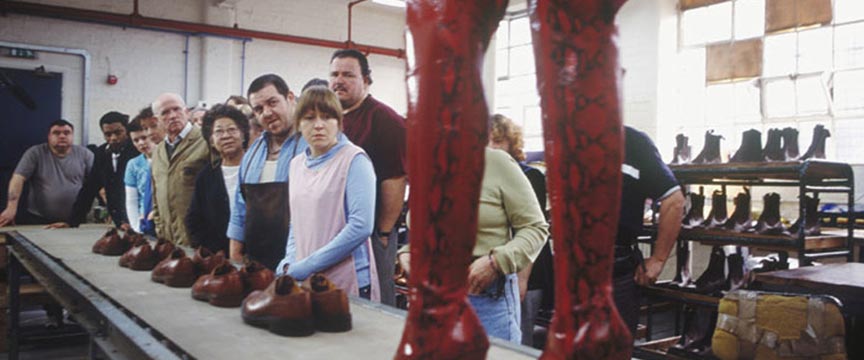
Most of the interior factory sequences were filmed at the historic Tricker's factory on St Michael's Road in Northampton. Tricker's traces its history to 1829, while its longstanding Northampton factory remains associated with traditional British shoemaking. The company itself notes the building's role as the setting for most of the factory interiors seen in Kinky Boots.
Other Northamptonshire locations were also used. Earls Barton, the village associated with Steve Pateman and W.J. Brookes, appears in the film, including the churchyard at All Saints used for the funeral sequence. Filming locations also included Wellingborough and other English locations, as well as Milan.
This connection has survived long after filming ended. Northampton's museums and heritage organizations continue to discuss Kinky Boots as part of the region's industrial story. Film-related footwear has appeared in museum collections and exhibitions, and the movie has become an accessible way of introducing new audiences to Northamptonshire's once-dominant shoe industry.
In that sense, the film preserves something beyond its fictional story: the physical environment, machinery, craft traditions, and working culture of British footwear manufacturing.
The Cast and Chiwetel Ejiofor's Lola
Although Kinky Boots is structured around Charlie's effort to rescue Price & Sons, the performance that attracted the greatest attention was Chiwetel Ejiofor's Lola.
Lola could easily have become a broad comic stereotype. Instead, Ejiofor gives the character confidence and theatrical extravagance while also exposing vulnerability, particularly when the story explores Lola's relationship with her father and the expectations placed on her as Simon.
That emotional complexity became central to the film's reputation.
Joel Edgerton provides a deliberately more restrained counterweight as Charlie. He portrays someone burdened by inherited expectations and initially uncomfortable with both his responsibility for the factory and Lola's world.
Nick Frost's Don embodies some of the prejudice Lola encounters. Their confrontations allow the movie to address masculinity and intolerance through humor and conflict. Sarah-Jane Potts' Lauren, meanwhile, is instrumental in encouraging Charlie to stop thinking exclusively about the factory's traditional product and search for an underserved niche.
The ensemble helps make the factory feel like a community rather than merely a setting. That distinction matters because saving Price & Sons means saving jobs, skills, relationships, and a way of life.
Critical Reviews and Audience Response
Critical reaction to Kinky Boots was mixed, and that division helps explain the film's reputation.
Rotten Tomatoes currently records a Tomatometer score of 58 percent based on more than 100 reviews, while its audience score is substantially stronger at 74 percent from tens of thousands of ratings. That difference is revealing.
Critics frequently praised Ejiofor while arguing that the screenplay followed a familiar formula associated with British working-class comedies such as The Full Monty. Some thought the movie was too cautious with potentially provocative material and resolved conflicts too predictably.
The Guardian's Peter Bradshaw similarly recognized the familiar Calendar Girls and Full Monty formula while finding the film uneven. Another Guardian review by Philip French described the story in terms of Priscilla, Queen of the Desert meeting The Full Monty and highlighted both its predictability and Ejiofor's engaging performance.
Yet the characteristics that frustrated some critics appear to be precisely what appealed to many viewers.
Audience reactions repeatedly emphasize that the film is funny, touching, hopeful, easy to watch, and driven by a strong central performance. Rather than seeking a confrontational treatment of sexuality and gender identity, the movie presents its themes through the familiar structure of a workplace comedy about people learning to respect one another.
That accessibility helped give Kinky Boots an unusually long cultural afterlife.
Awards and Recognition
The film's most prominent awards recognition centered on Chiwetel Ejiofor.
Ejiofor received a Golden Globe nomination for Best Performance by an Actor in a Motion Picture – Comedy or Musical. He was also nominated for a British Independent Film Award and received recognition from other critics and film organizations.
The film itself won audience awards, including Best International Feature at the Florida Film Festival and Best Comedy at the Indianapolis International Film Festival.
These audience awards are especially appropriate given the film's later history. Kinky Boots was never primarily celebrated as an austere critics' film. Its strength was its ability to make audiences respond emotionally to an unconventional combination of industrial decline, entrepreneurship, drag performance, comedy, and friendship.
The movie also appeared at the 2006 Sundance Film Festival, where it played as part of the festival's Premieres program. Sundance later revisited the film, including it in a Summer Film Series screening a decade after its festival appearance.
Popularity and Commercial Performance
Kinky Boots was not a blockbuster on the scale of a major Hollywood franchise. Reported worldwide theatrical grosses were approximately $10 million, meaning that its theatrical footprint was comparatively modest.
Judging its importance solely by its original box office, however, badly understates its eventual reach.
The movie accumulated an audience through theatrical exhibition, home video, television, digital distribution, streaming, and word of mouth. Its review-aggregation history shows tens of thousands of audience ratings, while continued studio availability and retrospective coverage demonstrate that the film has remained in circulation long after its original release.
More importantly, the property experienced something relatively rare: its stage adaptation became considerably larger than the original film.
The movie effectively became the narrative foundation for a global theatrical brand.
From Kinky Boots the Movie to Kinky Boots the Musical
The most significant chapter in the film's legacy began when producers recognized that its combination of factory workers, drag performance, fashion, comedy, and emotional transformation could work particularly well onstage.
Producer Daryl Roth encountered the film at Sundance and saw theatrical potential in its story. Hal Luftig independently reached a similar conclusion. The film rights were secured, and Kinky Boots was developed into a musical with a book by Harvey Fierstein, music and lyrics by Cyndi Lauper, and direction and choreography by Jerry Mitchell.
The Broadway production opened in 2013 with Stark Sands as Charlie and Billy Porter as Lola.
It became a major success.
Kinky Boots received 13 Tony Award nominations and won six, including Best Musical. Billy Porter won Best Actor in a Musical, Jerry Mitchell won for choreography, and Cyndi Lauper won Best Original Score. Lauper's victory was historically significant because she became the first woman to win the Tony for Best Original Score alone.
The musical subsequently reached London's West End and numerous international and touring productions.
This transformed the historical importance of the movie. Viewers who discovered the stage musical often worked backward to the film, while movie audiences became curious about how its characters and story had been reinterpreted through Fierstein's book and Lauper's songs.
The relationship can even be seen in retrospective audience comments about the film, with viewers explicitly mentioning watching it before seeing the musical.
Cultural and Social Significance
The lasting significance of Kinky Boots comes partly from its ability to connect subjects that might initially seem unrelated.
One is industrial change.
Charlie represents a generation inheriting businesses built for an economic world that no longer exists. Price & Sons cannot survive merely by producing the same excellent product its predecessors manufactured. Tradition without adaptation becomes a liability.
Another is entrepreneurship.
The factory's salvation comes from identifying a customer whose needs mainstream footwear companies have ignored. Lola provides not simply inspiration but market knowledge. She understands the customer because she is part of the customer community.
The third is identity.
Charlie and Lola appear radically different, yet both struggle with expectations inherited from their fathers. Charlie feels pressure to become the kind of factory owner his father expected. Simon/Lola carries emotional wounds connected to a father who rejected his identity and choices.
The movie gradually reveals that both characters are dealing with variations of the same problem: how much of a parent's definition of masculinity should determine a son's life?
That parallel gives Kinky Boots more emotional substance than its flamboyant title suggests.
The film also brought a drag character into a relatively mainstream feel-good comedy at a time when drag culture had substantially less visibility in mainstream entertainment than it would acquire in subsequent years. Its treatment can appear cautious when viewed from a contemporary perspective, and critics have long noted that the screenplay often chooses reassurance over confrontation. Nevertheless, Lola is not merely a joke or peripheral spectacle. She is indispensable to the business, the plot, and the emotional development of the people around her.
The Broadway adaptation magnified those themes and carried them to an even larger international audience.
Shoes, Craftsmanship, and the Movie's Unusual Appeal
Footwear is more than a comic device in Kinky Boots.
Shoes represent family inheritance for Charlie, personal expression for Lola, employment for the factory workers, engineering for the craftspeople, and economic survival for Price & Sons.
The actual manufacturing problem behind the story is also surprisingly interesting. A dramatic stiletto boot designed for a heavier wearer is not simply a standard women's boot made in a larger size. Materials, lasts, heels, structural reinforcement, dimensions, balance, and manufacturing methods all matter.
That technical reality anchors the comedy.
Northampton's shoemaking heritage makes the setting particularly appropriate because the region had the expertise required to solve exactly this sort of manufacturing challenge. The real Steve Pateman did not save his business simply by choosing an outrageous new style. He researched a customer base, invested money in machinery, modified construction methods, and produced footwear capable of doing something existing products could not reliably do.
The film turns that practical manufacturing innovation into entertainment.
The Website as a Piece of Internet and Film History
KinkyBoots-Movie.com is now valuable as more than a destination for basic movie information.
It represents the dedicated promotional websites that accompanied theatrical films during the 2000s. Such sites often served as temporary digital marketing centers containing trailers, production information, cast material, photographs, downloads, and other promotional features. Once a theatrical campaign ended, many were abandoned, redirected, allowed to expire, or disappeared as studios redesigned their web infrastructure.
The surviving KinkyBoots-Movie.com domain now presents itself retrospectively as the former official website and incorporates archived material together with later reviews and audience commentary. That means the present site should not be confused with Miramax's current official film page.
Publicly accessible authoritative sources do not clearly establish the present registrant or operator of KinkyBoots-Movie.com, so claims about current ownership should be made cautiously. Historically, however, the domain's significance derives from its connection with the movie's original web presence and promotional era.
Its current contents concentrate heavily on the movie itself: basic production details, the trailer, synopsis, memorable dialogue, professional reviews, a lengthy review of the film, and audience responses.
In effect, the domain has shifted from movie marketing to movie preservation and rediscovery.
Kinky Boots Today
More than two decades after the film was made, Kinky Boots occupies an unusual position in popular culture.
It is simultaneously a small British comedy-drama, a fictionalized version of an extraordinary Northamptonshire business story, a showcase for an early major Chiwetel Ejiofor performance, a record of Britain's traditional shoe-manufacturing environment, and the source material for one of the most successful Broadway musicals of the 2010s.
Its physical legacy remains visible in Northamptonshire. The story of Steve Pateman and Divine Footwear continues to appear in local industrial-history resources, while Northampton Museum & Art Gallery has preserved Kinky Boots-related material as part of the county's footwear heritage. The Tricker's factory remains particularly significant because viewers can see an authentic working environment rather than a completely fabricated movie set.
The story has consequently come full circle. A local factory's attempt to survive industrial decline became a BBC documentary. The documentary inspired a feature film. The feature film inspired a Broadway musical. The musical became an international success. That success renewed public interest in the real factory and Northamptonshire's shoemaking history.
KinkyBoots-Movie.com belongs to that chain of cultural history.
For someone encountering the domain today, the most useful way to understand it is therefore not simply as an old movie website. It is a surviving digital marker for the point at which an obscure but ingenious British manufacturing story was being transformed into international popular culture.
The red boots may be the memorable visual symbol, but the larger story is about adaptation: a factory adapting to a changing market, Charlie adapting to unwanted responsibility, workers adapting to unfamiliar people and ideas, Lola negotiating different versions of herself, and eventually a modest British film being adapted into an enormously successful musical.
That capacity for reinvention is ultimately what has kept Kinky Boots relevant long after its original movie website completed its promotional purpose.